

Kitten Math
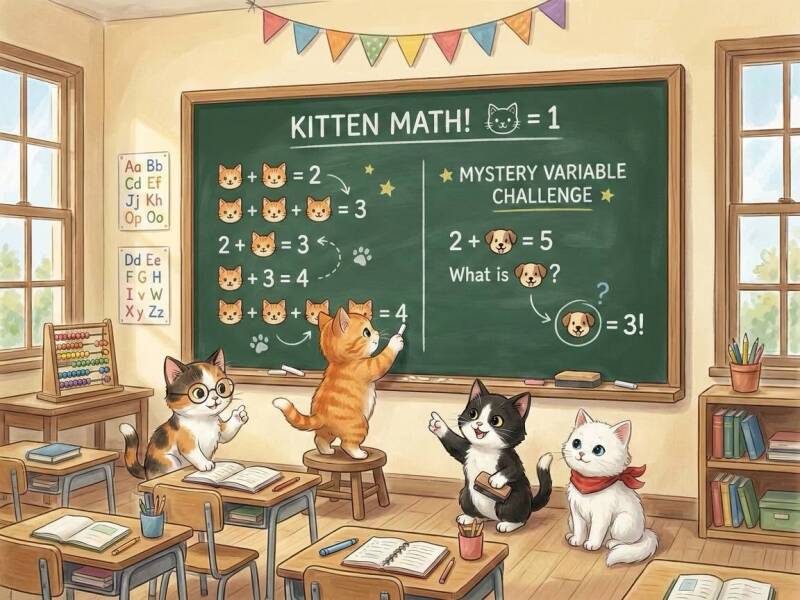
Most people think of math education as a ladder of isolated worksheets: first you count, then you memorize addition facts, then years later someone hands you an x and expects you to care. What if we built the entire bridge — from early counting all the way to algebra, fractions, geometry, beginner statistics, and genetics — using something learners already observe and care about every day? Welcome to Kitten Math.
A kitten is always 1; a puppy is a mystery box.
Concrete Counting & Number Sense (Kitten = 1)
One kitten equals 1. Counting paws, grouping kittens into baskets, and sorting coat patterns turn abstract quantities into something tangible.
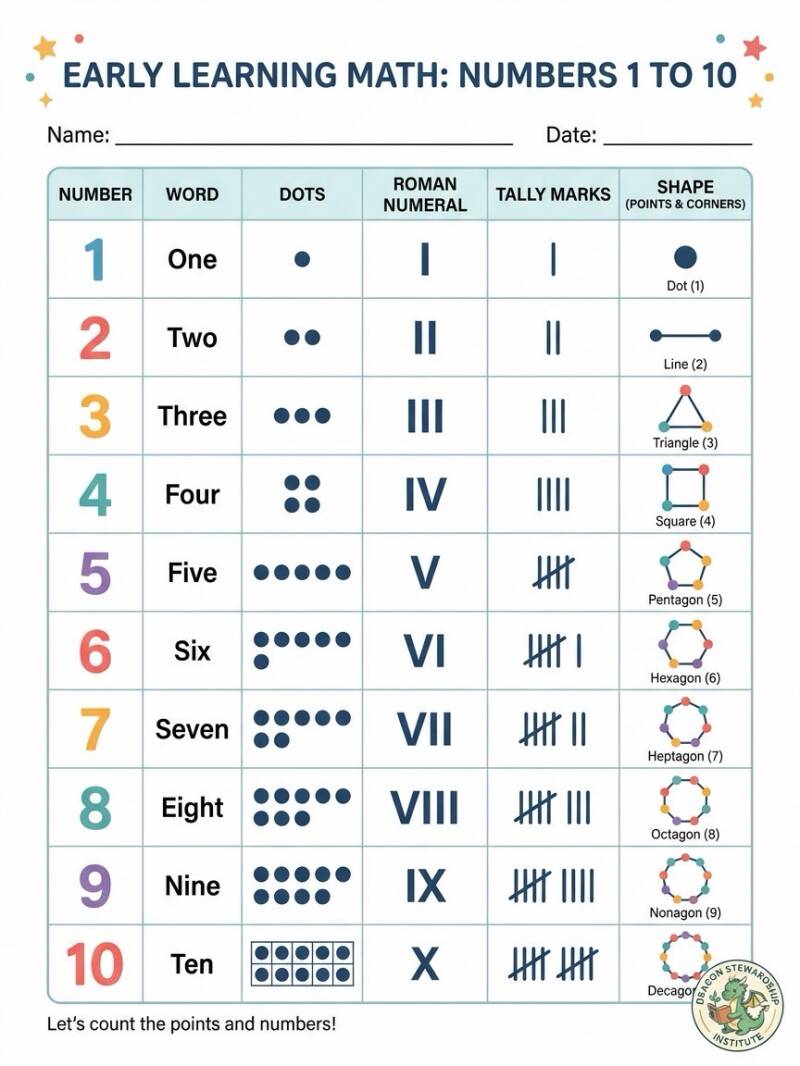
Early Algebra (The Puppy Variable)
A single puppy is an unknown mystery variable: 2 kittens + 1 puppy = 5, so the puppy must equal 3.
Fractions & Complementary Parts (Cat + Puppy = 1)
A cat and a puppy together make 1 whole: 1/2 + 1/2 = 1, 1/4 + 3/4 = 1.
Geometry & Scale (Kittens Made of Kittens)
A larger shape built from smaller copies of itself: units vs. wholes, packing and gaps, area vs. perimeter.
Beginner Statistics (Pooling Class Observations)
Pool class observations into a shared dataset: frequencies, mean vs. median, range, and why measurement definitions matter.
Cat Level: Genetics & Inheritance
Coat patterns unlock real biology: X-linked inheritance, X-inactivation, epistasis, dilute alleles, and temperature-sensitive colorpoints.
Try some problems
A taste of what's inside the guides — problems first, answers right there so you can see how the teaching works.
Counting: Kitten + Kitten + Kitten = ___ — Answer: 3. Every kitten is 1.
The puppy variable: 2 + [Puppy] = 5 — what is [Puppy]? — Answer: 3.
The fractions bridge: If [Cat] + [Puppy] = 1 and [Cat] = 1/4, what is [Puppy]? — Answer: 3/4.
Geometry: A kitten silhouette is made of smaller copies of itself where each step shrinks side length to 1/5 of its previous size. How many times smaller is each sub-kitten's area? — Answer: 1/25 of the area.
Geometry: Double every side length of a square mat. Perimeter doubles, but by what factor does the area increase? — Answer: 4.
Angles: Classify a hind leg bent at 65°, a tail held at 90°, and a leap extending to 115° as acute, right, or obtuse. — Answer: 65° is acute, 90° is right, 115° is obtuse.
Genetics: Predict the expected offspring phenotypes and sexes from a cross between a tortoiseshell female (XOXo) and a non-orange black male (XoY). — Answer: 25% tortoiseshell/calico females, 25% black-based females, 25% orange males, 25% black-based males.
Statistics: Pool your class's pet observations into one dataset — which observation sits furthest from the middle (the median), and what measurement factor might explain it?
The whole series, from beginner math to cat genetics, is $50. The bundle includes the instructor's guides, 30 copies of student materials, the Trait Database, The Coral and Theodore, The Cricket and the Frog, When to Use the Different Branches of Math, and the Firefly Riddle — each with 30 copies for students to read along. Students will need their own field book or laptop.
The whole series for homeschool, with 10 copies of each, is $40. The bundle includes the instructor's guides, 10 copies of student materials for each guide, the Trait Database, The Coral and Theodore, The Cricket and the Frog, When to Use the Different Branches of Math, and the Firefly Riddle — each with 10 copies for students to read along. Students will need their own field book or laptop.
Good pedagogy doesn't hide rigor behind cuteness — it uses familiar, living systems so learners can cross every mathematical bridge with their eyes open.