

Stewardship of Legend
Every child already knows how to care for something real before they ever meet an equation. When we begin mathematics with familiar pets—kittens curled in a ten-frame, cats carrying patterns in their coats and data in their traits—numbers stop feeling like cold marks on a worksheet. A child counting paws, sharing treats evenly, or tracking whether a tabby coat skips a generation is doing real quantitative reasoning anchored in affection and observation. Pets provide the first safe bridge: they are tactile, beloved, and close enough to touch, proving early on that math is simply a way of paying honest attention to living things.
Once that trust is built, the imagination can scale without losing its footing. From familiar housemates, learners step outward into legend—meeting dragons that test momentum and buoyancy in deep water columns, wizards who track instantaneous rates of change across shifting terrain, phoenixes that mark the thresholds where systems collapse and reorganize, griffins that read the self-similar geometry of broken mirrors across every magnification, and unicorns that guard moral accountability so no living subject is ever erased by a convenient group average.
Why move from household pets to mythical creatures? Because each tier holds a consistent biological container while expanding what a young mind can carry. Familiar animals anchor early numeracy and data hygiene in daily life; legendary creatures give older concepts vivid form without stripping away rigor or turning complex systems into flat, lifeless abstractions. Instead of meeting arithmetic, genetics, physics, calculus, fractals, and ethics as disconnected subjects trapped in separate textbooks, young learners grow up seeing the entire architecture at once in living coherence—understanding how a small rule iterates into a larger pattern, how a boundary shapes what moves inside it, and how every calculation carries responsibility toward the subjects it describes.
This curriculum is built for the kids, and for the adults who guide them—whether gathered around a kitchen table with ten student copies for a homeschool co-op or working across a classroom of thirty desks. Every bundle keeps instructor guides and worked keys separate from clean, ready-to-use student sets so educators can focus on discovery rather than prep. By starting with the critters children already love and rising toward the stewardship of legend, we give the next generation more than isolated procedures: we give them a unified way to measure, question, and care for the whole world in front of them.
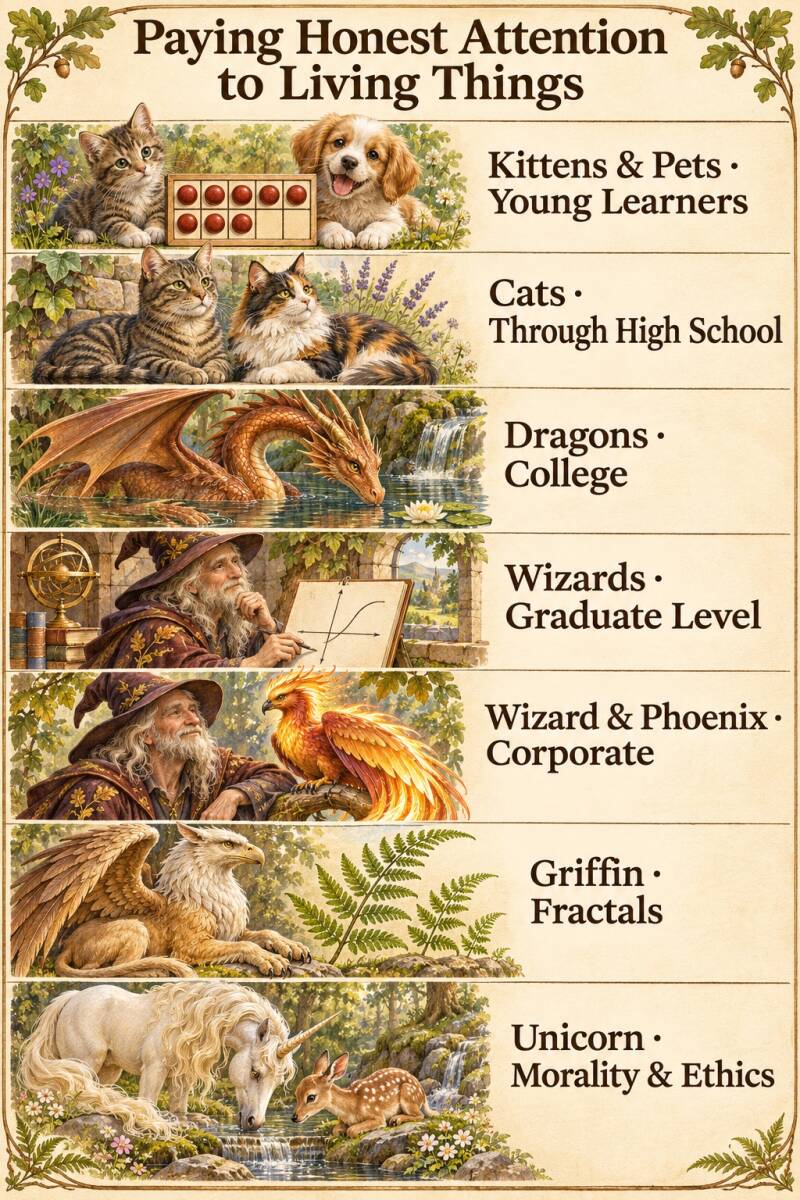
The Curriculum Ladder
The first five rows tell readers who the lessons are for. The last two tell them what questions to carry forward.
Kittens — Elementary school: early mathematics and logic.
Works: Kitten Math: Complete Bundle ($50)
Works: Kitten Math: Homeschool Bundle ($40)
Cats — High school: applied data and genetics.
Works: inside the Kitten Math bundles — cat genetics, statistics, and the Trait Database.
Dragons — College: biological physics and geometry.
Works: Physics Teachings — School Bundle ($100)
Works: Physics Teachings — Homeschool Bundle ($80)
Wizards — Calculus: rates of change and accumulation.
Works: inside the Physics Teachings bundles — the Dragon's Calculus Match (instructor guide and student worksheets).
Wizard + Phoenix — System states: thresholds, regime shifts, and resilience.
Works: Corporate Bundle ($100, product 25058852)
Works: Business Bundle ($35, product 25059612)
Griffins — Advanced fractals: recursive scaling and broken mirrors. Does this pattern hold when I change scale? Coming soon — sneak peek.
Works: coming soon — Griffin Fractals teaching bundle.
Works: For now: the Fractals bundle ($3, product 25010884)
Unicorns — Ethics and philosophy: consequence tracing and subject fidelity. Whose experience might my summary conceal? Coming soon — sneak peek.
Works: coming soon — Unicorn Math bundle. The Unicorn Math module is written and ready.
Both questions reach all the way back to the kittens.
Kitten Math
Most people think of math education as a ladder of isolated worksheets: first you count, then you memorize addition facts, then years later someone hands you an x and expects you to care. What if we built the entire bridge — from early counting all the way to algebra, fractions, geometry, beginner statistics, and genetics — using something learners already observe and care about every day? Welcome to Kitten Math.
Golden Rule: A kitten is always 1; a puppy is a mystery box.
1. Concrete Counting & Number Sense (Kitten = 1) — One kitten equals 1. Counting paws, grouping kittens into baskets, and sorting coat patterns turn abstract quantities into something tangible.
2. Early Algebra (The Puppy Variable) — A single puppy is an unknown mystery variable: 2 kittens + 1 puppy = 5, so the puppy must equal 3.
3. Fractions & Complementary Parts (Cat + Puppy = 1) — A cat and a puppy together make 1 whole: 1/2 + 1/2 = 1, 1/4 + 3/4 = 1.
4. Geometry & Scale (Kittens Made of Kittens) — A larger shape built from smaller copies of itself: units vs. wholes, packing and gaps, area vs. perimeter.
5. Beginner Statistics (Pooling Class Observations) — Pool class observations into a shared dataset: frequencies, mean vs. median, range, and why measurement definitions matter.
6. Cat Level: Genetics & Inheritance — Coat patterns unlock real biology: X-linked inheritance, X-inactivation, epistasis, dilute alleles, and temperature-sensitive colorpoints.
Good pedagogy doesn't hide rigor behind cuteness — it uses familiar, living systems so learners can cross every mathematical bridge with their eyes open.
Dragon Physics
Standard physics problems often strip away context, leaving students with disconnected numbers on a blank page. Dragon Physics anchors every calculation in a distinct biological container — a creature whose mass, wing geometry, internal gas sacs, claw grip, or cranial resonators create real physical trade-offs.
When students solve problems for a Thermal Glider, Pelagic Diver, Pyrogenic Stoker, Lithic Anchorer, or Acoustic Resonator, they aren't just plugging values into equations. They are reasoning about how structure, environment, and physical limits shape what is possible.
What Makes This Approach Effective for Educators:
Built-In Physical Constraints: every dragon carries consistent anatomical and environmental parameters across multiple problems, helping students track units, boundary conditions, and scaling relationships rather than treating each question as an isolated trick.
Cross-Topic Transfer Within One System: a single biological container can span kinematics, fluid dynamics, thermodynamics, statics, and waves — allowing instructors to revisit familiar organisms as students build mathematical and conceptual maturity.
High Engagement Without Sacrificing Rigor: speculative ecology sparks curiosity immediately, while the underlying math stays grounded in real equations like the torque equilibrium sum, hydrostatic pressure, adiabatic compression, and the Doppler shift.
Flexible Classroom & Workshop Use: pair the illustrated profile cards with problem sets for warm-ups, lab extensions, inquiry discussions, or multi-level STEAM intensives — from introductory algebra-based physics to deeper analytical work.
From Abstract Formulas to Living Constraints: Dragon Physics treats each organism as a coupled physical system. Instead of memorizing isolated formulas, learners examine how mass, geometry, pressure, and energy flow interact inside a defined container — building stronger intuition for modeling real-world systems.
Physics Teachings: College-level dragon physics and calculus, built for classrooms and homeschools. Dragon Physics readings first, then the calculus — the Dragon's Calculus Match instructor guide with worked solutions, the Tiny Dragons water-column problem set, and The Dragon and the Fractalled Mirror, with student copies for reading along. Skills this bundle builds: calculus (rates of change, accumulation, related rates, maxima and minima, arc length, definite integrals); physics (Doppler shift and acoustic energy, hydrostatic pressure and isothermal compression, torque and tipping thresholds, impulse, momentum, and adiabatic work); thinking (variable-condition reasoning, checking units and orders of magnitude, subject before container).